
Chapter 1: Strategic Assurance: Leading Inclusion from the Board
Why Board Leadership Matters
Boardroom leadership sets the tone for the entire school or trust. Under the Department for Education's Every Child Achieving and Thriving framework and the Inclusive Mainstream Fund (IMF) guidance, inclusion and belonging are no longer treated as pastoral goals or specialist tasks delegated solely to the SENCO or SEND Link Governor.
By 31 December 2026, every school and trust is required to publish an evidence-based Inclusion Strategy detailing how core budgets and IMF allocations remove barriers to learning. To meet this statutory deadline effectively, forward-thinking boards are already mapping this requirement to their meeting cycles, reviewing drafts during the summer term and ratifying the final strategy in early autumn to prevent a compliance-driven December rush. Boards are expected to foster, approve, monitor, and report on this strategy as a core indicator of educational quality.
Belonging starts at the board table. When governors model psychological safety, clear communication, and inclusive decision-making, that culture trickles down through senior leaders to staff and classrooms.
How Boards Can Lead
Leading inclusion requires setting a clear strategic expectation that every child belongs and can thrive in your school. To translate boardroom culture into classroom reality, boards must first recognise the vital distinction between "system actions" and "lived experience":
- Inclusion is the SYSTEM ACTION (What You Do): The deliberate choices, adaptive systems, policies, and budget allocations leaders make to remove barriers to access.
- Belonging is the LIVED OUTCOME (What People Feel): The real experience, showing how pupils, staff, and families actually connect, feel safe, and thrive as a result of those systems and actions.
With this distinction in place, boards can drive inclusion through five strategic leadership actions:
- Aligning Ambition and Inclusion: Establishing that high academic standards and strong inclusion reinforce each other. Inclusion is not a lower standard, but the framework that enables every pupil to achieve.
- Approving the Statutory Inclusion Strategy: Holding executive leaders accountable for producing a published Inclusion Strategy that pools core budgets and IMF allocations around the DfE’s 7 Principles of Inclusion, focusing on doing a few high-impact universal approaches exceptionally well. The first principle is ambitious leadership and governance that embeds inclusion; school leaders, governors, and trustees must establish a clear, school-wide culture of high expectations for all pupils, including those with SEND and disadvantaged learners. Inclusion is embedded in strategic planning, accountability structures, and resource allocation rather than treated as an add-on.
- Championing Inclusive Systems: Expecting behaviour frameworks, school environments, and budget choices to keep vulnerable children learning alongside their peers, building the internal support needed to sustain their attendance and belonging.
- Directing Focus to "Bright Spots": Encouraging leadership to seek out where vulnerable pupils are attending best and participating most, and helping scale those successful classroom adaptations across all year groups.
- Anchoring Strategy in Pupil Belonging: Ensuring the school's strategic plan explicitly evaluates pupil culture against four core outcomes: feeling safe, respected in their identity, heard in decisions, and connected to trusted adults.
Trust Board Spotlight: MAT Governance in Action
In Multi-Academy Trusts, inclusion requires a dual governance approach. The Trust Board holds legal accountability for compliance, funding, and strategy across all academies, while Local Governing Bodies offer the local window on the school to monitor lived experience.
Building on the principles of our earlier guide, Locally Led, Strategically Strong, Trust Boards can lead inclusion across a MAT through three strategic levers:
- Trust-Wide Strategy, Locally Adapted Delivery: The Trust Board approves the overarching MAT Inclusion Strategy and sets common metrics, while delegating local contextual monitoring (pupil culture, local family trust) to local boards.
- Strategic Pooling of IMF Funding: Trustees oversee how Inclusive Mainstream Fund allocations and core SEN budgets are combined across schools, enabling small or vulnerable academies in the trust to access shared specialist expertise, training, and resources.
- Cross-Trust "Bright Spot" Scaling: When an individual academy develops an exceptional adaptive teaching practice or support-first attendance model, the Trust Board uses its vantage point to scale that bright spot across every school in the trust.
How Boards Can Monitor
1: Moving from Reassurance to Assurance:
In governance, there is a dangerous difference between reassurance and assurance:
- Reassurance is passive: "The headteacher assures us that the school culture is inclusive and welcoming."
- Assurance is active and evidence-backed: "We have examined policy, analysed data, and listened to pupil and staff voice to understand where inclusion is working."
2: Moving from Deficit to Appreciative Inquiry:
When boards review culture, equality, or attendance, the traditional approach is usually deficit-based: Why are complaints rising? What are we doing wrong? Deficit-led questioning puts school leaders on the defensive and results in compliance-driven tick-box exercises.
At Shaping Governance, we teach boards to lead through appreciative, solution-focused inquiry. Instead of diagnosing failures, appreciative boards search for "bright spots", the moments, classrooms, or departments where inclusion and belonging are already strong, and ask how leadership can scale those conditions across the whole school.
The Appreciative Shift
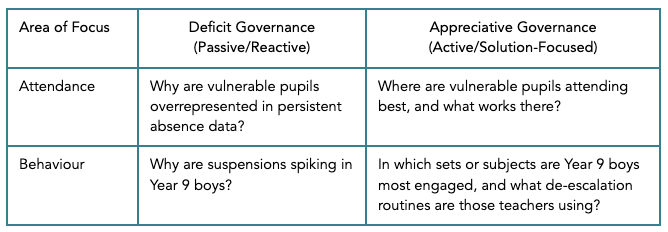
When governors ask solution-focused questions, they create psychological safety in board meetings. This allows school leaders to be open about challenges while keeping the focus on practical, scalable solutions.
3: Using three Layers of Assurance
To gain assurance that a school or trust is inclusive, governors must look beyond single data sets, reports and summaries. Effective monitoring requires triangulating three distinct layers of evidence:
- System Evidence (Are policies & budgets designed to include?): The board-approved Inclusion Strategy (published on the website), IMF budget tracking, adaptive teaching policies, and support-first behaviour frameworks.
- Data Evidence (Do numbers show high participation for all?): Demographic-segmented attendance, repeat suspension rates, and extra-curricular participation figures.
- Lived Experience (Do pupils, staff & families feel safe and valued?): Anonymised pupil, staff, and parent survey trends, governor link visit observations, and focus group insights.
Practical Tips for Board Meetings
- Put Culture First: Move inclusion and strategic culture items to the top of the agenda, before routine finance and compliance papers.
- Start with a "Bright Spot": Open inclusion discussions by asking senior leaders to share one specific classroom or department where inclusion is working exceptionally well and what is driving that success.
- Request a 1-Page Summary: Ask executive leaders for a high-level inclusion dashboard rather than a lengthy report.
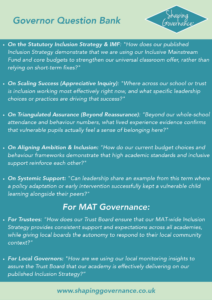
Try using some of the questions below at your next board meeting:
About the Author & Shaping Governance
Su Turner is the founder of Shaping Governance and author of Locally Led, Strategically Strong. She works with school boards, MAT trustees, and executive leaders across the country to transform governance from a compliance exercise into an active driver of school improvement and learner belonging.
Learn more about our appreciative board reviews, training packages, and governance tools at www.shapinggovernance.co.uk or connect directly with Su on LinkedIn.